


SaaS marketing teams are publishing more content than ever. Blog cadence is up. Keyword coverage is wider. Editorial calendars are full. And yet, for the majority of B2B SaaS companies, the contribution of content to qualified pipeline is flat or falling.
The temptation is to blame execution. The writing isn’t sharp enough. The SEO isn’t aggressive enough. The team needs more resources. We hear it all. But in our experience, the problem is usually upstream of all that. It sits in the strategy itself, in what the content is built to achieve, who it’s built for, and how success gets measured.
Most SaaS content programmes are optimised to generate activity: traffic, impressions, email signups, keyword rankings. These are not bad things. But do not confuse them with commercial impact. The gap between activity and pipeline is where most SaaS content strategies quietly fail, and where the sharpest one’s win.
This piece lays out what a pipeline-first SaaS content strategy actually looks like: what it prioritises, how it’s structured, what it measures, and why the usual playbook is, you guessed it…. now out of date.
Why SaaS content operates under different rules
Content marketing advice tends to be written as though every business sells the same way. It doesn’t.
A SaaS company selling a $40k annual contract to an enterprise buying committee operates in a completely different reality from a direct-to-consumer brand selling a $30 subscription. We’re not saying that there aren’t similarities, but SaaS content must do fundamentally different work. It has to reach different people. Critically, it has to hold up across a buying process that might take three months, involve six stakeholders, and require sign-off from procurement, IT, and a budget holder who has never even visited your website.
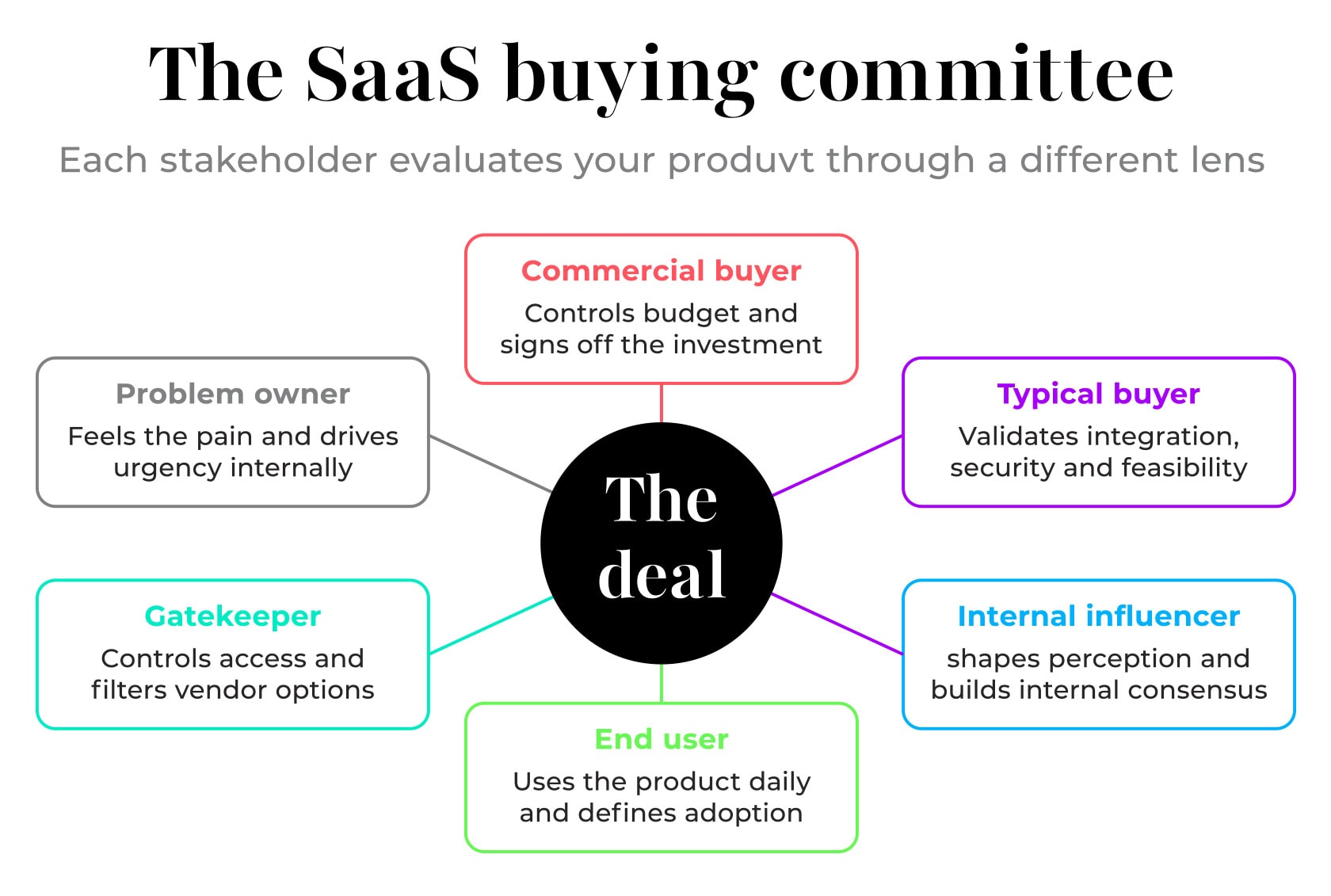
That complexity is the defining feature of SaaS content strategy. The buying committee is rarely one person. A head of marketing might find your comparison article. A CTO might need your integration documentation. A CFO might want your ROI calculator. Each of those people has a different question, a different risk tolerance, and a different reason to say no. Content that only speaks to one of them leaves the others to fill in the blanks, or worse, to fill them in using a competitor’s material.
Sales cycles compound this. SaaS deals don’t close on impulse. Buyers research, shortlist, evaluate, trial, negotiate, and then decide. That process creates dozens of moments where content could either accelerate the deal or let it stall. If your content library only covers the awareness stage, you’ve built a front door with no rooms behind it.
Product complexity adds another layer. SaaS products are often technical, configurable, and deeply integrated into existing workflows. Shallow content gets ignored because it doesn’t match the depth of the decision. A buyer comparing two security platforms doesn’t need a blog post explaining what cybersecurity is. They need content that helps them evaluate whether your platform fits their specific architecture, compliance requirements, and team structure.
None of this means SaaS content marketing is harder than other sectors. It means it’s different. And strategies borrowed from B2C, media publishing, or generalist content marketing will consistently underperform because they weren’t designed for this buying environment.
The traffic trap: how volume-first thinking fails SaaS marketers
For the better part of a decade, the dominant SaaS content playbook looked roughly the same. Find high-volume keywords. Publish at scale. Measure success by traffic growth and email signups. Build a large top-of-funnel audience and trust that some percentage will eventually convert.
That playbook had a logic to it. Search engines rewarded volume. Domain authority compounded. And in a world where organic clicks flowed reliably from rankings, casting a wide net made a certain kind of sense. It worked pretty well for a lot of brands.
That world is now contracting
Google’s AI Overviews now appear across a significant and growing share of search queries, and the impact on click-through rates is severe. AI-generated search features are suppressing clicks even for top-ranking content. Ahrefs found that, as of December 2025, AI Overviews reduced organic click-through rate to the top-ranking page by 58%. The queries most affected are exactly the ones that volume-first SaaS strategies target: informational, educational, and definitional searches.
The poster child for this shift is HubSpot. Long considered the benchmark for content-driven SaaS growth, HubSpot reportedly experienced traffic declines of 70 to 80% as AI Overviews rolled out through 2025. Their strategy was purpose-built to dominate high-volume informational keywords. When those keywords started getting answered directly on the search results page, the architecture that made HubSpot’s content engine so impressive became the same architecture that made it so exposed.
HubSpot is not a cautionary tale about bad content. Their content is excellent. It’s a cautionary tale about strategic dependency on a single traffic model, one that assumed informational search would always generate clicks.
Chegg’s experience pushed this further. The educational SaaS platform reported a 49% decline in non-subscriber traffic between January 2024 and January 2025, and filed an antitrust lawsuit alleging Google used their content to train AI systems that now compete directly with them. When your entire content model relies on answering informational queries that AI can synthesise faster, cheaper, and without a click, the model is structurally at risk.
But the counter-evidence is just as instructive. Across our own SaaS client portfolio, where content strategies focus on bottom-of-funnel, commercially-focused keywords, we’ve seen traffic declines of only 10 to 20%, compared to the 40 to 50% losses widely reported elsewhere. More importantly, conversion rates held steady or improved, because the content was built around keywords where buyers are actively looking for solutions, not just looking for information. Those queries trigger AI Overviews less often, and when they do, the brand still tends to get cited in the summary because the content is specific, product-relevant, and commercially detailed.
That means that the type of content you build determines your resilience. Traffic from informational keywords was always a proxy metric. AI just made that impossible to ignore.
We’ve seen this play out directly with our own clients. One B2B SaaS company came to us running a conventional top-of-funnel content strategy: editorial stories aimed at their target buyer persona. The content was well-written. It generated traffic but converted at near zero. When we dug into the data, we found that a few bottom-of-funnel posts, articles targeting keywords with clear buying intent, were converting at 6 times the rate of everything else, despite sitting well outside the top ten posts by traffic volume.
That insight gave the client confidence to stop prioritising volume and start prioritising commercial proximity. The result was a leap in monthly trial signups from content, built on a foundation of fewer, more targeted articles aimed at people already in the market for a solution.
The point isn’t that top-of-funnel content has no value. It does. The point is that starting there, measuring success by traffic, and hoping the funnel sorts itself out is a strategy that was already underperforming before AI Overviews accelerated its decline.
What SaaS content should actually be optimised for
If traffic is not the right primary metric, what is?
The answer depends on what you believe content’s job is in a SaaS business. If you believe its job is to attract attention, then traffic makes sense. If you believe its job is to create the conditions for qualified pipeline, the metrics shift considerably.
A pipeline-first SaaS content strategy optimises for five things
1. Qualified pipeline contribution.
This is the clearest commercial measure: how many qualified opportunities did content influence, and what’s the revenue value attached to them? Not traffic. Not email signups. Pipeline that sales recognises, works, and closes.
2. Proposition clarity.
Every piece of content should make the product’s value sharper for the reader. If someone reads a comparison article and comes away less certain about what you do, the content has failed regardless of how well it ranks.
3. Buying-committee progression.
Content should help different stakeholders make progress in their own terms. A technical evaluation guide moves the CTO forward. A total-cost-of-ownership analysis moves the CFO forward. A change-management resource moves the operations lead forward. Each piece serves a different person in the same deal.
4. Sales enablement.
If the sales team doesn’t use your content, it’s not doing its job. The best SaaS content libraries are built with sales input and sales usage as the north star.
5. Retained discoverability across Google and AI surfaces.
Content needs to show up where buyers are researching, and increasingly, that means both traditional search results and AI-generated answers. Content that AI models cite tends to be specific, authoritative, and structured around clear claims with supporting evidence. That’s good content by any standard, but it requires intentional design.
The difference between an activity-led strategy and a pipeline-led one shows up most clearly in what gets prioritised and what gets measured.
| Activity-led | Pipeline-led | |
|---|---|---|
| Primary metric | Traffic, keyword rankings | Pipeline influence, revenue attribution |
| Content prioritisation | High-volume informational keywords | High-intent commercial and evaluation keywords |
| Starting point | Keyword research tools | Customer research, sales conversations, support data |
| Audience model | Broad personas | Specific buying-committee roles |
| Success signal | Traffic growth, email signups | Demo requests, sales-attributed content usage |
| Relationship to product | Loosely related to category | Directly tied to use cases, objections, and buying scenarios |
| AI resilience | Low (informational content most exposed) | Higher (commercial content less frequently absorbed by AI Overviews) |
Most SaaS content programmes sit somewhere between these two columns. The ones that consistently generate pipeline lean heavily toward the right.
A framework for SaaS content that drives pipeline
Strategy without structure is just opinion. Here’s how to turn the principles above into a working content programme.
Get the proposition right before you scale the content
This sounds obvious but too often teams skip it.
If the homepage doesn’t clearly articulate who the product is for, what problem it solves, and why it’s different from the alternatives, the blog cannot fix that. Content can amplify a clear proposition, but what it cannot do is substitute for a weak one.
Before scaling content production, pressure-test the basics. Can a first-time visitor understand what you do within ten seconds of landing on the homepage? Do the product pages explain specific use cases, or do they describe features in abstract terms? Is the messaging consistent across the site, or does every page sound like a different company wrote it?
If the foundations are shaky, fix them first. Content that drives traffic to a confusing product story just creates expensive confusion.
Start with real customer friction, not keyword volume
The best SaaS content ideas don’t come from keyword research tools. They come from the people closest to the customer.
Sales teams hear the same objections, questions, and hesitations across dozens of calls every week. Support teams see where users get stuck, confused, or frustrated. Customer success teams know which outcomes matter most to retained accounts. Product teams know what the roadmap is solving for. Community forums and review sites surface the language buyers actually use when they’re evaluating options.
That material is the richest source of content ideas available to any SaaS company, and most of them barely touch it. They start with Ahrefs or Semrush, filter by volume, and build a calendar around keywords that look promising on a spreadsheet. Whether those terms have any connection to the buying conversation comes secondary.
The smarter workflow inverts this. Start with customer friction. Identify the real questions, objections, and decision points that shape the buying process. Then check whether those topics have search demand. Often they do and the keywords that come up are more commercially valuable than anything a volume-first approach would have surfaced.
Prioritise content by commercial proximity
Not all content is equally close to a buying decision. Comparison articles, alternative evaluations, use-case fit guides, implementation walkthroughs, ROI frameworks, and integration documentation sit much closer to the point of conversion than a “What is [category]?” explainer.
Start there.
The client I mentioned earlier is a perfect example of this. When their content strategy pivoted from broad editorial to commercially-proximate SEO content, conversion rates spiked. The articles that drove signups were not the ones with the most traffic. They were the ones that answered the questions buyers ask when they’re already in the market for a solution.
This doesn’t mean you only write bottom-of-funnel content. It means you build the commercial foundation first, prove it works, and then expand. A SaaS company with strong comparison pages, detailed use-case content, and clear implementation guides has a content library that converts. A SaaS company with fifty blog posts explaining industry concepts and no decision-stage content has a content library that informs, which is a different and less commercially valuable thing.
Build for the full journey, but don’t start broad by default
There’s a fair counterargument here. Brand awareness matters. Top-of-funnel content builds domain authority, earns backlinks, and puts the brand on the radar of buyers who aren’t yet in-market. So ignoring it entirely would be shortsighted.
This is all to say that the sequencing of content matters more than most teams admit. If you start broad, you generate traffic that doesn’t convert, struggle to demonstrate ROI, and often lose internal support before the strategy has time to mature. If you start commercially and expand once the pipeline contribution is proven, you build credibility, demonstrate value, and earn the mandate to invest in broader content.
The best SaaS content strategies cover the full buying journey. The best-executed ones build from the bottom up.
Measure contribution, not output
Publishing cadence is not a KPI. Neither is keyword count, word count, or the number of articles shipped per month. These are operational inputs. They tell you how busy the team is. They tell you nothing about whether the content is creating commercial value.
The metrics that matter sit in three tiers
Visibility metrics tell you whether the content is being found: rankings, impressions, share of voice, and increasingly, AI citations across platforms like ChatGPT, Perplexity, and Google’s AI Overviews. These are leading indicators.
Engagement quality metrics tell you whether the right people are paying attention: time on page, scroll depth, return visits from target accounts, and content consumption patterns within ABM programmes. These are qualifying indicators.
Commercial metrics tell you whether the content is contributing to the business: pipeline influenced by content, demo requests from organic landing pages, content used by sales in active deals, branded search lift, and revenue attributed to content-assisted journeys. These are outcome indicators.
Most SaaS teams over-report on the first tier and under-report on the third. That imbalance is not a reporting problem, it’s a strategy problem. When you measure traffic, you optimise for traffic. When you measure pipeline, you optimise for pipeline. It’s a mentality shift for a lot of SaaS content marketers.
Content types that earn their place
A pipeline-first strategy needs specific types of content, each serving a clear purpose in the buying process.
Decision-stage SEO content: targets the keywords buyers search when they’re actively evaluating options. Category terms (“project management software”), comparison terms (“Asana vs Monday”), and alternative terms (“Salesforce alternatives”) all signal high buying intent. These pages should exist before anything else in the content library.
Use-case and role-based content: speaks to specific people with specific problems. A page explaining how your platform helps RevOps teams consolidate reporting is more useful than a generic features page, because it mirrors how the buyer actually thinks about their own situation.
Comparison and alternative content: is often neglected because it feels uncomfortable to name competitors. But buyers are already comparing, so if you don’t provide that comparison, someone else will, and they’ll control the narrative.
Implementation and migration content: reduces one of the biggest friction points in SaaS buying: the fear that switching will be painful. Detailed, honest content about how onboarding works, what the migration path looks like, and what to expect in the first 90 days directly addresses the objections that stall deals.
ROI and business case content: gives the budget holder something to work with. If your buyer needs to justify the spend internally, content that quantifies the value, ideally using real customer data, makes their job easier and your deal more likely.
Thought leadership and category POV content: earns the brand a seat at the table before the buyer enters a formal evaluation. This is where the company’s distinctive perspective on the market, the problem, or the direction of the category lives. It’s not top-of-funnel in the traditional sense, because it’s not targeting informational keywords. It’s building the mental availability that means the brand gets considered when the buying process begins.
AI-discoverable expert content: is the newest category and one that most SaaS companies haven’t yet built for intentionally. Content that AI models cite tends to be structured, specific, well-sourced, and built around clear claims rather than broad generalisations. Writing for AI discoverability isn’t a separate discipline. It’s a natural consequence of writing content that’s genuinely useful, specific, and authoritative.

Where most SaaS content strategies go wrong
The mistakes tend to cluster around a few recurring patterns.
Treating traffic as proof of success is the most common. A blog post that generates 10,000 visits and zero pipeline contribution is not a success. It’s an expense. Traffic is a distribution metric, not a business outcome, and conflating the two leads to content programmes that look impressive on a dashboard and deliver nothing to the sales team.
Outsourcing content without enough product depth creates a different kind of problem. Freelance writers and generalist agencies can produce competent content, but SaaS buyers can tell when the writer doesn’t really understand the product, the market, or the specific problem being addressed. The result is content that reads well but says nothing a competitor couldn’t also say. In a market where differentiation matters, generic competence is not enough.
Producing AI-generated content at scale is the 2025 version of this same trap. The cost of production has collapsed, and many SaaS teams have responded by publishing more. But more content that sounds like every other AI-generated article in the category just builds noise. Search engines and AI models are both increasingly able to distinguish between content that adds genuine perspective and content that simply restates what already exists.
Failing to support multiple stakeholders leaves gaps in the buying process. If your content only speaks to the end user, you’ve left the budget holder, the IT team, and the procurement function to evaluate your product without your input. That’s a risk you can control.
Weak internal linking between strategic and commercial content wastes the authority you’ve built. If a high-ranking thought leadership piece doesn’t link to your comparison pages, use-case content, or product pages, you’re generating awareness without creating a path to conversion. Internal linking is not an SEO technicality. It’s the architecture that turns individual pages into a system.
Publishing without a distribution plan assumes that ranking is the only way content gets read. For some content types, that’s true. For others, particularly thought leadership, new research, and category POV pieces, distribution through email, social, sales outreach, and partner channels is what gives the content reach. Pressing publish and waiting for Google is not a strategy.
How to tell whether your content strategy is working
Measurement should answer one question: is this content making it more likely that qualified accounts buy from us?
Start with visibility. Are we ranking for the keywords that matter commercially? Are we appearing in AI-generated answers for queries relevant to our buyers? Is our share of voice in the category growing or shrinking? These metrics tell you whether the content is being found by the right people.
Move to engagement quality. When target accounts visit our content, what do they do? Are they reading deeply or bouncing? Are they returning? Are they consuming multiple pieces across the site? If you’re running ABM programmes, are target accounts engaging with content at rates that suggest genuine interest rather than accidental clicks?
End with commercial impact. How many qualified opportunities were influenced by content? Which specific articles appeared in the buying journey of closed deals? Is the sales team actively using content in outreach, and if so, which pieces? Has branded search volume increased as content coverage has expanded? Can you trace a line, even an imperfect one, from content consumption to pipeline?
No attribution model is perfect. Multi-touch SaaS buying journeys are messy, and any model that claims precise credit allocation is oversimplifying. But imperfect measurement of the right things is vastly more useful than precise measurement of the wrong ones. Knowing that a comparison article influenced twelve qualified opportunities last quarter, even if the attribution is directional, is more valuable than knowing that a blog post generated 8,000 visits and an unknowable number of eventual conversions.
The content strategy SaaS needs now
The shift underway in search is not a temporary disruption. Gartner predicted that traditional search volume would drop 25% by 2026, with AI agents absorbing the difference. That prediction is broadly tracking. Organic click share has declined between 11 and 23 percentage points across multiple verticals between January 2025 and January 2026. The informational content that powered the previous era of SaaS content marketing is the most exposed category.
But this is not a story about content becoming less valuable. It’s a story about what “valuable” now means.
The SaaS companies that will win the next phase of content marketing are the ones that stop treating content as a traffic machine and start treating it as a system: a system for earning discovery across both search and AI surfaces, for building trust with specific buying-committee members, for reducing the decision friction that stalls deals, and for increasing the odds that qualified accounts move closer to revenue.
That requires sharper messaging, more commercial thinking, better customer research, and a willingness to measure what matters rather than what’s easy to count.
The traffic era rewarded volume. The pipeline era rewards clarity.
Frequently asked questions
Bottom-of-funnel content targeting high-intent keywords can generate pipeline contributions within three to six months, depending on domain authority and competitive density. Broader awareness and authority-building content typically takes six to twelve months to compound meaningfully. The key is starting with commercially-proximate content that can demonstrate ROI quickly, which earns the internal support and budget to invest in longer-term plays.
Yes, but the type of content matters more than it ever has. Informational content targeting “what is” and “how to” queries is increasingly answered by AI directly, reducing click-through. Commercially-focused content targeting evaluation, comparison, and implementation queries remains more resilient. Companies should also optimise for AI discoverability: being cited in AI-generated answers can be more valuable than a traditional top-three ranking for some query types.
Start by tracking which content pages appear in the buying journeys of closed and in-progress deals. Use CRM data, marketing attribution tools, and sales feedback to identify which articles, guides, and resources buyers engaged with before converting. Combine this with organic landing page conversion data and branded search trends to build a directional picture of content’s commercial contribution. No model is perfect, but measuring pipeline influence, even approximately, is more useful than reporting on traffic alone.
Prioritising traffic over commercial relevance. Most SaaS teams build content calendars around high-volume keywords, publish at scale, and measure success by visits and rankings. This creates activity without necessarily creating pipeline. The most effective SaaS content strategies start with the keywords and topics closest to the buying decision and expand from there, ensuring every piece of content has a clear commercial purpose before it gets published.
Want to boost your budget?
The Rubicon Agency Budget Booster is designed to optimise funds – making your available $/£/€ go 15% further than it would have done previously.
Think of it as 15% extra – free of charge.
Get in touch with our team
From brand transformations to demand engines, we help ambitious B2B companies achieve extraordinary results.
Discover how The Rubicon Agency can solve your toughest marketing challenges.