
Category

Our industry

Lessons from history for (disruptive) tech marketers

Retro Tech Marketing Advertising

Take a look back at the early days of technology marketing and you’ll discover a rich seam of material for amusement.

However, what might have passed for legal, decent and truthful may have been guilty of committing other crimes.

In the early 80s, print advertising was still a dominant media. So, imagine the scene when the geeks from the computer company met the creatives from the advertising agency. With the Account Director acting as referee, they would wrestle with the challenge of translating the client’s enthusiasm for bits and bytes into features and benefits that would spark ideas from the creative team.

Compared to today’s multi-media, multi-format, multi-message marketing, the classic format of advertising headline, image, copy and call-to-action seems limited. But with a team which included an Art Director, Writer, Photographer, Typesetter and Artworker, the agency would craft single or double page ads and billboard posters for the technology that would eventually disrupt the advertising industry itself.

By enabling and merging creative skills and processes, the all-conquering Apple Macintosh computer was the Trojan Horse welcomed into the confines of the creative industry to disgorge a cargo that created both threat and opportunity.

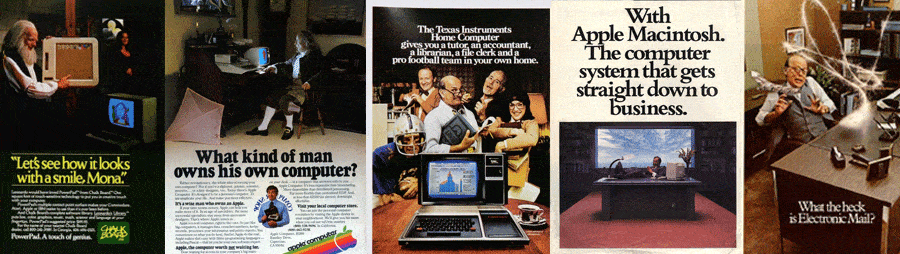
The early 80s saw the first ripening of Apple, primarily as a Technology Transformer and later, it could be said, as a Social Shaper. As an early mover, Apple was also an early victim of crimes perpetrated by the advertising industry. The evidence includes this press ad:

Retro Apple Computer Advert

Let’s start with the positioning. Side-stepping the headline (which borders on discriminatory) the copy is striking an uncomfortable balance between personal and business use and between independent entrepreneurialism and corporate captivity.

The marketing strategy seems to be based on convincing an individual, rather than a decision making group, to be persuaded to spend a ‘downright affordable’ $2500 on a personal computer rather than suffer the delays and ‘uncreative drudgery’ of using a big mainframe. This is slightly at odds with the subsequent suggestion that Apple makes things easy with three (count them) programming languages that ‘let you be your own software expert’. Not exactly the most compelling proposition for someone who was just beginning to warm to the idea of uncomplicating their life.

As the Internet was only a twinkle in Tim Berners Lee’s eye, the call to action had to rely on a toll free telephone number with an address (should the prospect prefer to put pen to paper) and the third option of a request for information via the magazine publisher. With a response mechanism like that, the agency must have had a few sleepless nights, waiting to count those inbound responses.

That’s the words, what about the pictures?- a Benjamin Franklin character in full period costume? Looks like agency creatives suffered from the same affliction that drove 80s music video directors to plunder ideas from the nearest theatrical dressing-up box. It’s also interesting to see actual ‘product’ juxtaposed against the period furniture as if to say ‘here at last is that bright white shiny future we were promised by technology’. Today, it begs the question: when was the last time you actually saw a router or blade server in a marketing campaign?

Finally, it’s nice to see the copywriter couldn’t resist the line: ‘Apple is a real computer, right to the core’ though hardly surprising it didn’t make it to strapline status (probably over-ridden by SJ himself).

With the benefit of 20:20 hindsight it’s easy to criticise this early foray into tech marketing but we can also learn some lessons from it. Whether you’re a Market Maker, Technology Transformer or Social Shaper, it pays to understand where you are on your marketing roadmap , where you need to be and what needs to be said and to whom in order to get you there. Above and beyond the advantages of innovations such as digital media, the Internet and social strategies, we can employ the advantages of messaging and content that’s segmented for business and technical decision makers; realistically set against a clear adoption curve and single-minded in its proposition.

To paraphrase the ad, you may not have to be a wise man/person to own an Apple pc or any other technology for that matter, but it helps if you want to convince people to buy.

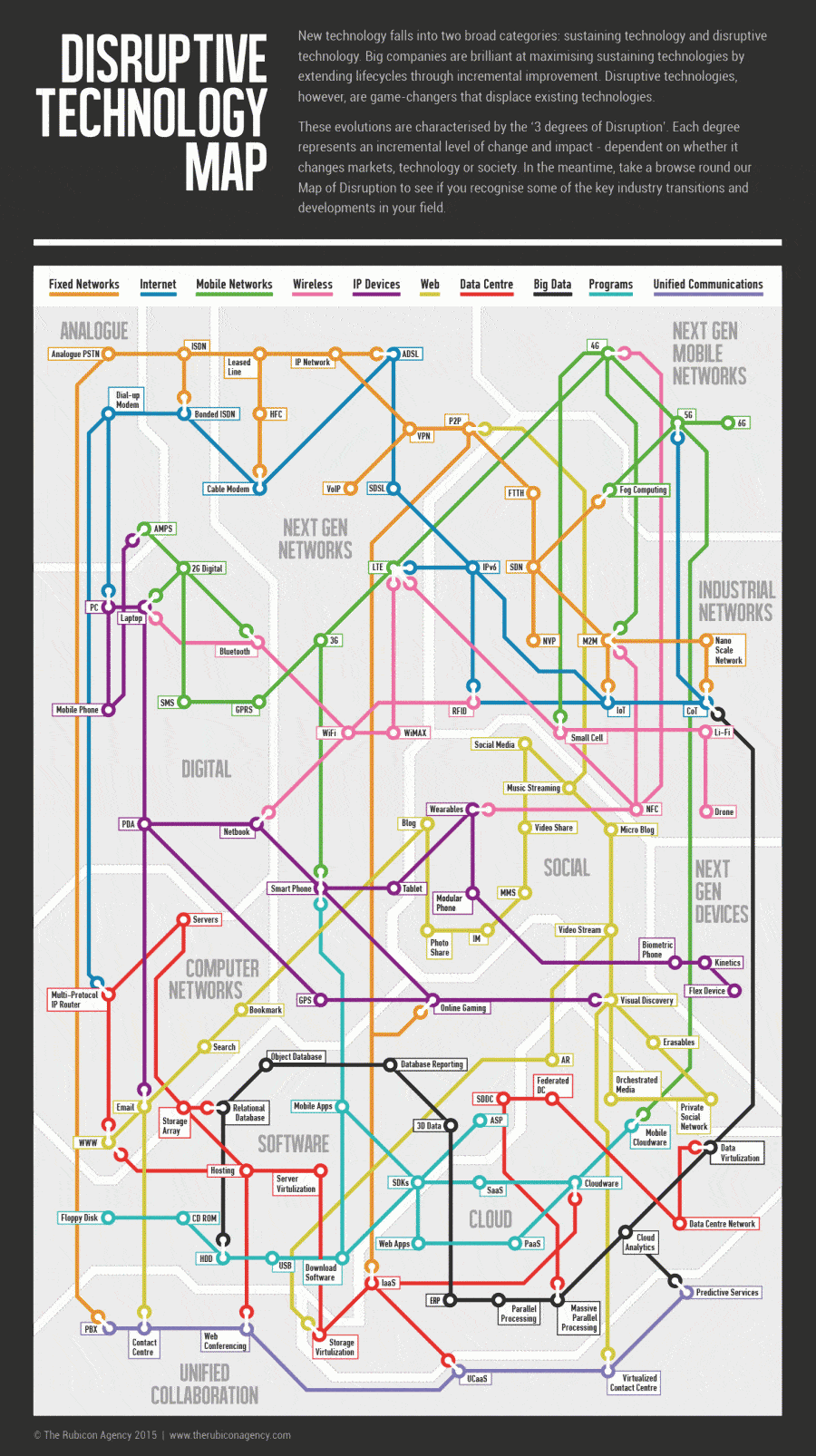
Map of technology disruption

Blog: The path to Disruption

Disruptive technologies don’t just displace sustaining technologies, they can also unsettle or displace customer, partner and channel relationships and even business models.

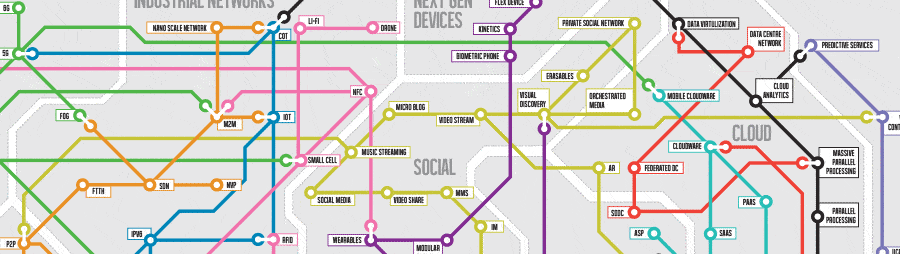
Take a look at our  Map of Technology Disruption infographic below and you’ll see plenty of examples of technology disruptions that combined with other factors to offer ‘disruptive innovation’ and create new challenges for technology marketers. Take SMS for example: when the Short Messaging Service was introduced to mobile phones, who knew that the original strategy to market to business users would be overtaken by the mass adoption of ‘Txt Msg’ by a nascent market of socially active teenagers?

Disruptive Technology journey infographic

Technology markets don’t buy disruption

Technology markets don’t buy disruption

In the world of technology, new or better doesn’t necessarily mean disruptive.

Unless ‘new’ means revolutionary and ‘better’ means businesses and markets have to think or behave differently, then it’s not true disruption.

Do an online search for  ‘disruptive technology’ or ‘disruptive innovation’ and you’ll see they stir up discussion and debate. Talking of Google, here’s a good example: the Google search engine algorithm was not in itself disruptive. It was AdWords, its advertising service. By offering a self-service ad product for as little as $1, it disrupted the previous model sustained by Yahoo who in turn had sustained the traditional advertising model of premium rates for display advertising.

Combine disruptive technology with business models, sales, market and economic dynamics and it becomes part of a bigger displacement which is disruptive innovation. Computers are a prime example of disruptive innovation. Whilst the original mainframe computers were a technology innovation, they only began to create significant, global disruption when the concept of ‘one computer, many users’ was overturned with the introduction of personal computers which enabled ‘one user, many computers’.

People don’t buy disruption, they buy ‘better’. Understanding what’s better can often be a challenge with disruptive technology. Sometimes, it doesn’t fall neatly into the categories of bigger, better, faster or even cheaper.

The first mobile phones were certainly bigger than we’re used to today and they could in no way claim to be cheaper than landline phones. Whilst they were seen as ‘desirable’ they were also open to derision, accusations of elitism and viewed by horrified company accountants as unnecessary and very expensive. And of course, early mobile phones also had limited, unreliable network coverage for the small minority of early adopters who used them.

Taking disruptive technology and innovation to market means communicating effectively with early adopters right through to laggards. It means harnessing enthusiasm and managing scepticism with neither being confined exclusively to users and buyers – internal sales forces and external channels can be evangelists and sceptics too. With clarity, context, joined up thinking and realistic timescales, it can be done. And when it does succeed, the prize is much bigger and longer lasting for those technology companies that aren’t afraid to cross the rubicon.

Find out how TRA takes disruption to market at the point where technologies and business models are being displaced – when opportunity and threat co-exist.

Find out more