

A practical method for scoring the current brand, defining the intended position and turning the gap into a plan.
TrustRadius called 2024 “the year of the brand crisis” in B2B tech. That diagnosis has only become more awkward since. In software markets where buyers shortlist familiar names before they ever fill in a form, a SaaS brand audit is not a cosmetic exercise. It is a strategic check on whether your brand is memorable, credible and commercially useful enough to earn a place in the buyer’s mind before the buying window opens.
We see plenty of SaaS teams treat brand assessment as a polite prelude to design work. New website, fresher deck, tighter strapline, job done. Usually not. TrustRadius found that 78% of buyers building shortlists selected products they had heard of before starting research, rising to 86% among enterprise buyers, and its 2025 follow-up still showed most buyers already know the winner before the real comparison starts.
That matters even more in software because the buying process is crowded and political. Google and Bain put the average B2B buying committee at 17 cross-functional stakeholders, while Jenni Romaniuk’s work at Ehrenberg-Bass keeps pointing to the same uncomfortable truth: brands grow when they are easy to think of in buying situations and easy to buy when the moment comes.

A SaaS brand audit should diagnose growth friction, not polish
A serious SaaS brand audit starts from one question: what is this brand making easier, harder, clearer or riskier in the pursuit of growth? Not whether leadership is bored of the logo. Not whether the homepage feels a bit tired. Growth friction is the real object of study.
That means assessing the brand across strategy, message, memory, proof and experience. In SaaS, the issue is rarely one broken thing. More often the brand is directionally sensible but generically expressed. It sounds plausible in the boardroom, then forgettable in market. Buyers can understand it, but they do not retain it. Sales can repeat it, but cannot defend margin with it.
A workable process at a glance
| Step | Core question | Main output | Who needs to be involved |
|---|---|---|---|
| 1 | What does the market currently see, believe and remember? | Evidence-led current state | Brand owner, product marketing, sales, strategic lead |
| 2 | Which elements are strong, weak or generic? | Scored diagnostic | Small scoring group only |
| 3 | What does the brand need to become true for next? | Intent positioning by element | Leadership after the evidence is set |
| 4 | What must change in story, proof and expression? | Prioritised roadmap |
What should a SaaS brand audit actually measure?
A SaaS brand audit should measure how clearly the brand is positioned, how distinctively it is expressed, how well it maps to buying situations, how credibly it proves its claims and how consistently the promise survives across touchpoints. In other words, it should test strategic clarity, mental availability and commercial usefulness, not just visual neatness, which is exactly where Ehrenberg-Bass and Bain’s Elements of Value become useful lenses.
| Element | What you are assessing | Typical evidence |
|---|---|---|
| Category role | What market are we really in, and what job are we claiming to do? | Category map, competitor set, analyst and review language |
| Audience fit | Does the story work for buyer, user, technical evaluator and budget holder? | Interviews, sales calls, win-loss notes, deck variants |
| Positioning | Is the value proposition specific, ownable and commercially relevant? | Homepage, pitch deck, comparison pages, analyst framing |
| Message system | Can the core idea travel from corporate story to product, use case and proof? | Messaging docs, web IA, campaigns, enablement |
| Distinctive assets | Are visual and verbal cues recognisable enough to trigger memory? | Identity system, ad creative, events, social language |
| Proof and trust | Do claims feel earned, evidenced and low-risk? | Reviews, case studies, analyst quotes, ROI proof, trials |
| Experience consistency | Does the promise hold up from first impression to demo to onboarding? | UX, nurture flows, demo narrative, customer feedback |
That distinction matters, and it is why brand strategy work should sit upstream of identity debates. If the problem is the market story rather than the logo, the real fix is usually proposition development.
The SaaS brand audit scorecard
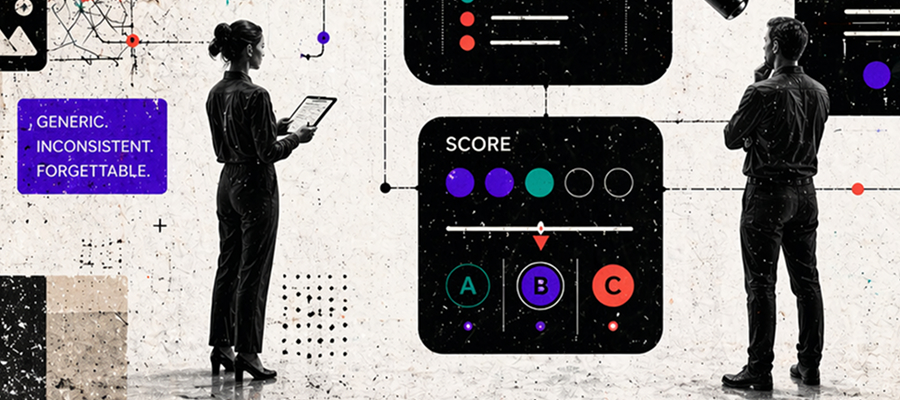
Most brand audits go soft at the scoring stage. Everyone agrees there are issues. Nobody wants to put a number on them. Then the loudest person in the room starts grading with their feelings and the whole thing turns into internal theatre.
How do you score the current brand without politics?
Score the current brand in two passes. First, assign a current-state score using evidence only. Second, assign an evidence-confidence rating so the team can see where it is relying on proof and where it is relying on hunches. Leadership can debate what to do next, but it should not rewrite the diagnosis before the evidence is on the table, which is consistent with the evidence-led discipline behind Ehrenberg-Bass thinking on category entry points.
| Score | Meaning |
|---|---|
| 1 | Confused, inconsistent or absent |
| 2 | Present, but weak and generic |
| 3 | Credible, but not yet distinctive |
| 4 | Clear, differentiated and repeatable |
| 5 | Strong, memorable and well evidenced |
Add an evidence-confidence grade as well
| Confidence | Meaning |
|---|---|
| A | Strong external and internal evidence agree |
| B | Some evidence exists, but gaps remain |
| C | Mostly opinion or incomplete evidence |
This is where discipline matters. Customer interviews, win-loss analysis, review-site language, search behaviour and sales objections all outrank executive instinct. Internal views still matter, but mainly because they reveal where the intended brand and the enacted brand have drifted apart.
We would also keep the scoring group deliberately small for the first pass. Usually that means the brand owner, the product marketing lead, a revenue stakeholder and one independent strategic lead. Wider leadership can and should join later, but only after the baseline is set. Otherwise the exercise gets diluted before it gets useful.
Intent positioning is not a wish list
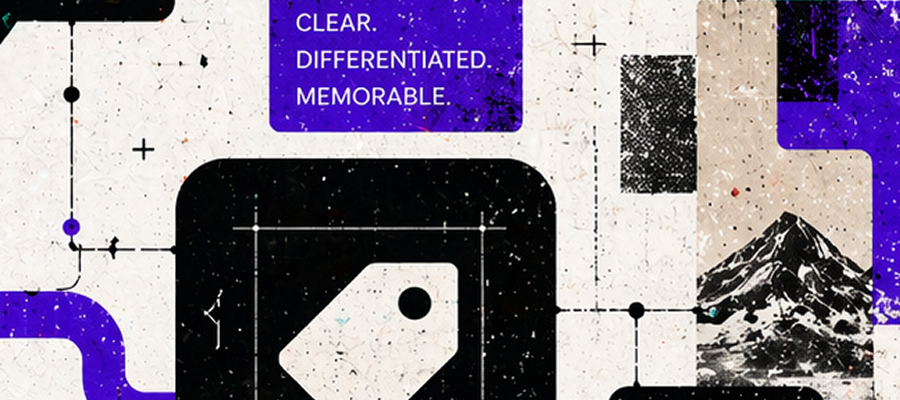
Once the current state is scored, the next job is to define the intended state. This is where many SaaS teams become unintentionally grandiose. Every dimension suddenly wants to be a five. Every message wants to sound category-defining. Every visual system wants to look iconic by Friday. That is not positioning. That is overcompensation.
How do you set intent positioning for each brand element?
Set intent positioning by asking what the brand needs to become true for over the next 12 to 18 months, given the category, the product roadmap, the commercial model and the buyer’s risk profile. The target state should be ambitious, but still supportable by proof, product reality and the kinds of memory structures the market can plausibly form, which is why category entry point thinking is so useful here.
A few questions make the exercise sharper:
- Which buying situations do we need to come to mind for more reliably?
- What must the brand be famous for, not merely capable of saying?
- Which claims can we evidence now, and which belong to the roadmap rather than today’s message?
- Where do we need to sound closer to category language, and where do we need to break from it?
- Which assets or phrases deserve disproportionate consistency because they help memory rather than just expression?
In practice, that means defining a target score for each element, then writing the strategic reason for the gap. If positioning is currently a 2 because it sounds like everyone else in the category, the real target may be a 4 rather than a mythical 5. If proof is a 1 because the category is high-risk and your validation is thin, that may become the priority ahead of identity work.
This is where companion content helps. The audit tells you what must change. The SaaS brand strategy guide should explain where the brand is heading, while the SaaS brand lookbook can show how category expression helps or hinders that ambition once both pieces are live. The brand strategy continuum is the more useful mental model here anyway. In software brands, change is usually cumulative, not ceremonial.

An external adviser stops you marking your own homework
This is one reason a third party is worth considering, especially when the audit might end in a significant clarification, elevation or repositioning. The same team that built the current story is rarely the best team to score it with perfect detachment. That is not a character flaw. It is just how organisations work.
An independent adviser can hold the line between evidence and preference. They can challenge category assumptions, separate signal from anecdote, spot where founder narrative is overpowering buyer reality and say, without internal baggage, that a cherished message is now dead weight.
That does not mean parachuting in to impose a house view. It means bringing a disciplined outside lens, then helping leadership socialise the implications without watering them down. That is the role we would expect from an adviser such as The Rubicon Agency: evidence first, category understanding second, creative expression third. In practice it often connects brand strategy, proposition development and the change-management work needed to make the new position usable rather than merely presentable.
The Nextira case study is a good example. Discovery and positioning workshops were used to reshape the name, message stack and identity around a more progressive future buyer, not to politely preserve the comfort of the old story.

From SaaS brand audit to 90-day action plan
A good audit produces a roadmap, not a moodboard. Once the current and intended states are clear, the final step is to convert the gap into a phased action plan.
| Timeframe | Priority | Typical outputs |
|---|---|---|
| Days 1–30 | Fix strategic ambiguity | Refined positioning statement, category framing, messaging principles |
| Days 31–60 | Fix market proof and message system | Homepage rewrite, sales narrative, case study plan, review capture, pitch deck |
| Days 61–90 | Fix expression and rollout | Identity updates, campaign language, web changes, enablement, measurement dashboard |
The order matters. Strategy before aesthetics. Proof before flourish. Message before multiplication. Otherwise you end up making weak positioning look more expensive.
We would also define success measures before rollout starts. That includes classic brand health signals such as recall, recognition and message consistency, but in SaaS it should also include shorter-path commercial indicators: stronger branded search, cleaner sales adoption of the narrative, better win–loss language and more persuasive proof on high-intent pages. TrustRadius’ shortlist research reinforces the same point: brand work should be judged by its contribution to future preference and present conversion, not by whether the launch deck gets a round of applause.
The useful thing about a SaaS brand audit is that it removes the romance from brand strategy. It shows, in plain terms, what the market is likely to notice, believe and remember. That is sobering. It is also exactly what makes it valuable.
Because the real risk is not that your brand changes too much. It is that it stays just plausible enough internally, while becoming increasingly invisible, generic or hard to trust externally. And by the time revenue feels that, the market has usually moved on without the courtesy of telling you first.
By The Rubicon Agency
Want to boost your budget?
The Rubicon Agency Budget Booster is designed to optimise funds – making your available $/£/€ go 15% further than it would have done previously.
Think of it as 15% extra – free of charge.
Get in touch with our team
From brand transformations to demand engines, we help ambitious B2B companies achieve extraordinary results.
Discover how The Rubicon Agency can solve your toughest marketing challenges.